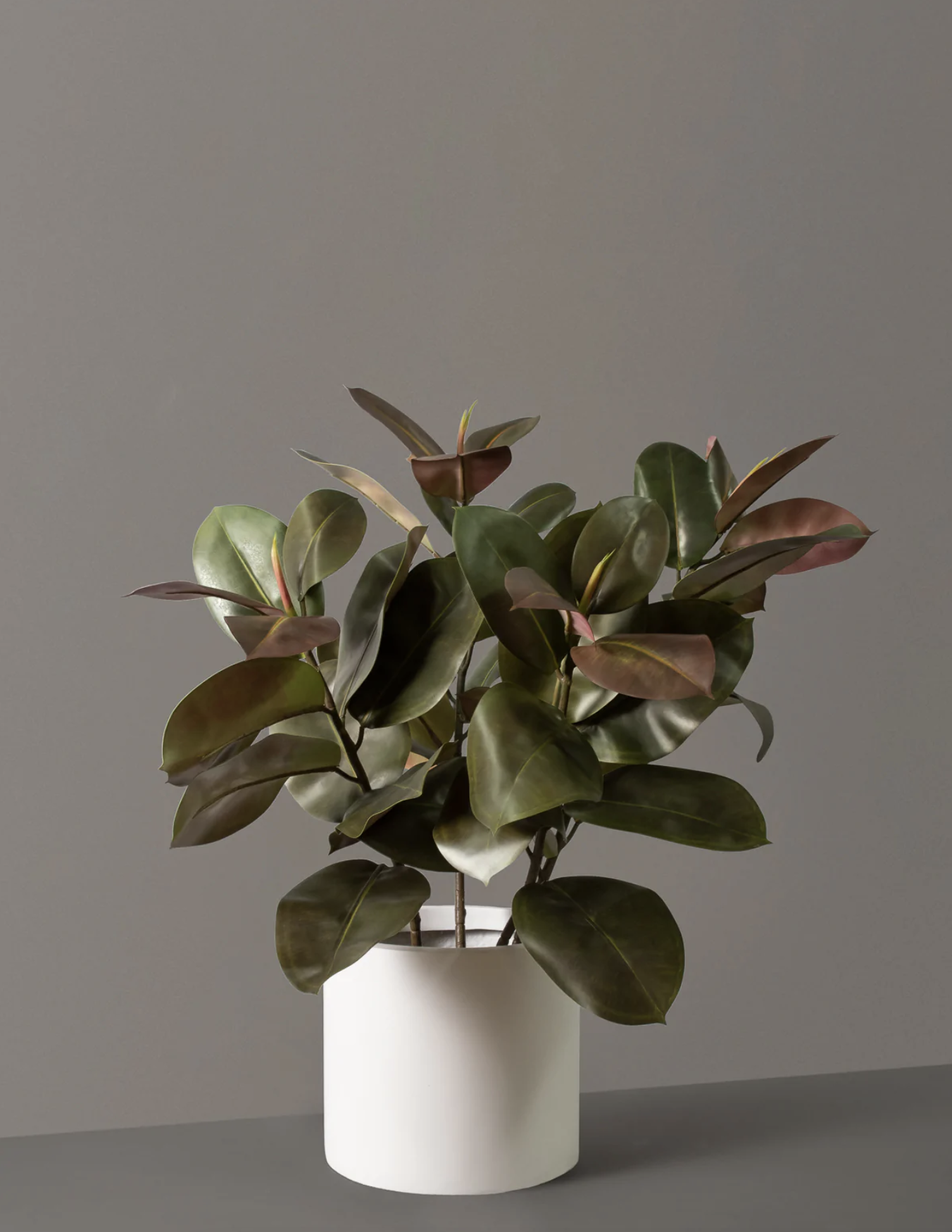
Native to southern China, Southeast Asia, and Indonesia, Ficus elastica is a species of evergreen tropical tree that makes for an excellent houseplant: It is tolerant of indoor light conditions, and NASA has even recommended its air-purifying properties.
The Ficus elastica’s family, Moraceae, is a family of shrubs, trees, and lianas; they are known for bleeding a latexy sap upon wounding, and exhibiting “foliar polymorphisms.” This means that their leaf shapes will be different for different stages of life, which is a unique and special feature, as most other plants exhibit the same leaf shapes throughout their lives.
Sunlight |
The Rubber Tree needs at least six to eight hours of light daily. This can be lower light at times, but it is best to give this species medium to bright light, preferably bright indirect. If your windows receive harsh direct sun, placing a sheer curtain over it can help diffuse the light. |
Water |
It is best to water your Rubber Tree every 1-2 weeks, allowing the soil to dry out between waterings. Opt for the more frequent end of the range when the plant is receiving more light, such as in spring or summer, and in the fall or winter, reduce the frequency. |
Humidity |
The Rubber Tree is quite unfussy when it comes to humidity—it can tolerate any level, including normal room humidity. |
Temperature |
It is best to aim for a temperature of 65°F to 85°F (18°C-30°C) for your Rubber Tree, and not let it go below 60°F (15°C). Remember, this plant is native to warm jungle climates! |
This plant is not a pet-friendly houseplant; it's considered toxic due to its milky sap. It is poisonous to cats, dogs, and humans if consumed. The best practice is always to keep these houseplants out of reach of small children and pets.